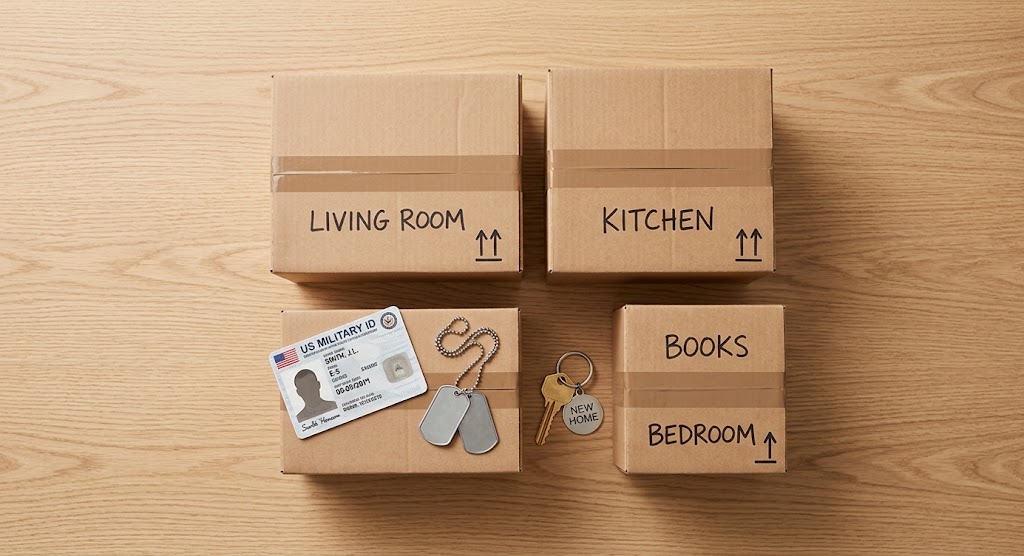
In Texas, what happens to your home when you die depends on your planning: with a mortgage, payments continue regardless. With no will, Texas intestate succession law decides your heirs through probate court. With a will, the home still goes through probate, just following your instructions. With a properly funded revocable living trust, Transfer on Death Deed, or Lady Bird Deed, the home passes directly to your beneficiary without probate.
A Texas Guide for Fort Cavazos (Fort Hood) Families
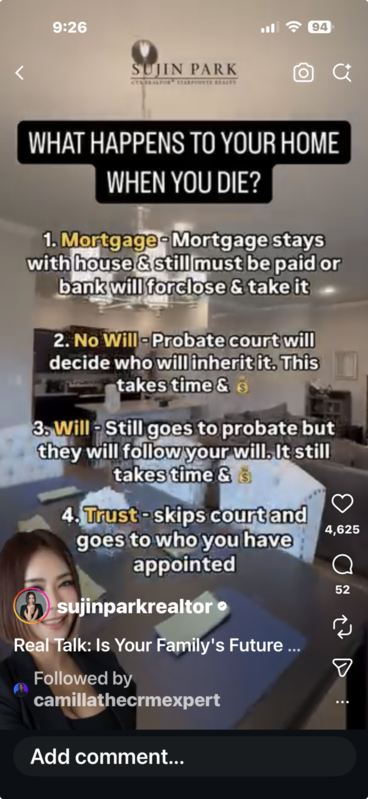
A while back I posted a quick video breaking down what actually happens to your home when you die — mortgage, no will, will, or trust — and it struck a nerve. People share it, save it, send it to their spouse with “we need to talk about this.” So I want to go deeper here, because four bullet points on a screen can only tell you so much, and this is exactly the kind of thing that matters more for military families than almost anyone else.
Here’s the truth: most of my clients haven’t thought about this at all, and that’s not a judgment — you’re focused on the PCS, the new house, the kids’ school. But this is the conversation I have with buyers more often than you’d think, especially after a deployment scare or a friend’s hard year. Let’s walk through it properly.
First, the mortgage doesn’t disappear
This is the one people misunderstand most. If you die owning a home with a mortgage, the mortgage doesn’t go away — it stays attached to the house. Whoever inherits the home either keeps making payments, refinances it, or sells it to pay off the loan. If nobody pays, the lender forecloses, same as it would with you. Inheriting a house isn’t free money; it’s inheriting the obligation that comes with it too.
If you don’t have a will: Texas decides for you
If you die without a will in Texas, you’ve died “intestate,” and the state has a built-in formula — found in the Texas Estates Code — for who inherits what. It’s not random, and Texas isn’t going to seize your house (that almost never happens, and only if literally no relative can be found). But here’s what actually happens: the probate court has to formally determine your heirs through a process called a Determination of Heirship, and then appoint someone — an administrator — to manage everything. That process takes time and money, and it follows a fixed legal formula regardless of what you actually would have wanted. If you’re married and your home is community property, your spouse usually inherits most or all of it — but the exact split depends on whether you have children from outside the current marriage, and that’s where things get more complicated fast.
If you have a will: better, but it still goes through probate
A will is absolutely better than nothing — it tells the court what you actually want, and Texas courts will generally follow it. But here’s the part that surprises people: having a will does not mean your house skips probate. Probate is the court process that validates the will and authorizes the transfer; the will is the instruction sheet the court follows during that process. In Texas, probate typically takes anywhere from a few months to over a year, depending on the complexity of the estate, and it does involve some cost — court fees, possibly attorney fees. Texas does have a relatively efficient probate system compared to a lot of other states (we have something called independent administration that cuts down on court supervision), but “more efficient than other states” still isn’t “instant.”
Trusts skip probate — but only if you do it right
A revocable living trust is the tool that actually avoids probate, and here’s why: when you put your home into a trust, the trust — not you personally — legally owns it. When you die, your successor trustee transfers it to your named beneficiaries directly, without court involvement. No probate, no Determination of Heirship, no waiting months for a judge’s approval.
The catch, and this is the part the four-second video version can’t cover: a trust only protects what’s actually inside it. This is called “funding the trust,” and it’s the single most common mistake I see — people create a trust, pay an attorney to draft it, and then never actually deed their house into it. If that happens, the house still goes through probate when you die, because legally, you still own it, not the trust. If you go the trust route, make sure the actual deed transfer happens, gets notarized, and gets recorded with the county.
One thing worth knowing if you’re a homeowner with a mortgage: a federal law (the Garn-St. Germain Act) specifically protects you here — your lender cannot call your loan due just because you transferred your home into a revocable trust where you remain the beneficiary. It’s a common fear, and it’s not founded. Notify your lender anyway, just so it’s documented, and double check your homeowner’s insurance lists the trust correctly.
The options the four-point list didn’t mention
Texas actually gives you two other tools that are simpler and cheaper than a full trust, and I think more military families should know about them:
Transfer on Death Deed (TODD). This is exactly what it sounds like — you record a deed naming a beneficiary who automatically inherits the house when you die, no probate required. You keep full control while you’re alive: you can still sell it, refinance it, or change the beneficiary whenever you want. It only takes effect at death.
Lady Bird Deed. A close cousin to the TODD, this lets you keep the right to sell or mortgage the property during your life, while it transfers automatically to your named beneficiary at death — also without probate.
Neither replaces a full estate plan if your situation is more complex (blended families, minor children, multiple properties), but for a lot of younger military families with one home and a straightforward situation, a TODD is a genuinely simple, low-cost way to solve the exact problem in my video — without the cost or maintenance of a full trust.
The military-specific part nobody talks about enough
This is where I think I can actually add something most general estate-planning content misses: your installation’s Legal Assistance Office will help you with a will and power of attorney for free. This is one of the most underused benefits available to service members. Before any deployment, it’s worth a visit — they’ll help you draft or update a will, set up the right power of attorney for your spouse or trusted family member, and make sure everything is structured correctly under federal law.
One more detail that catches people off guard: your beneficiary designations on things like SGLI (your life insurance) and your TSP or retirement accounts override your will. If your will says one thing but your SGLI beneficiary form says another, the SGLI form wins for that asset. After every major life event — marriage, divorce, a new baby, a PCS — it’s worth double-checking those beneficiary forms are still accurate, because a will alone won’t fix a mismatch.
What I’d actually tell you to do
If you remember nothing else: don’t let “we’ll get to it eventually” be the plan. At minimum, get a will done — it’s free through your installation’s legal office if you’re active duty, and not expensive if you’re not. If you own your home and want to skip probate entirely, a Transfer on Death Deed is the simplest place most families should start, and a living trust makes sense for bigger or more complicated estates. Whatever you choose, talk to a licensed estate planning attorney about your specific situation — what’s right for one family isn’t always right for another, especially with deployments and PCS moves in the mix.
I’m not an attorney, and I won’t pretend to be one here — but I am the person a lot of my clients call when they’re trying to figure out what questions to even ask. If you want a recommendation for a Texas estate planning attorney who understands military families, or you just want to talk through your situation, reach out. That’s what I’m here for.
(737) 203-0360 | sujinparkhenson.com
Sujin Park Henson is a REALTOR at StarPointe Realty in Killeen, TX, specializing in military relocation and VA loans for Fort Cavazos families. She speaks Korean and English and has helped hundreds of PCS families find homes in the Central Texas market.
This post is for general informational purposes only and is not legal advice. Estate planning laws are specific to your situation and can change. Please consult a licensed Texas estate planning attorney — and, if you’re active duty, your installation’s Legal Assistance Office — before making decisions about your will, trust, or other estate planning documents.
📚 SOURCES USED
- Texas State Law Library — Probate Law Guide, intestate succession overview, nonprobate property: https://guides.sll.texas.gov/probate/when-there-is-no-will and https://guides.sll.texas.gov/probate/nonprobate-property
- Texas Estates Code, Chapter 201 (official statute text): https://statutes.capitol.texas.gov/Docs/ES/htm/ES.201.htm
- Nolo Legal Encyclopedia — Texas intestate succession and avoiding probate in Texas (cites Tex. Est. Code throughout): https://www.nolo.com/legal-encyclopedia/intestate-succession-texas.html and https://www.nolo.com/legal-encyclopedia/texas-avoiding-probate-31945.html
- Texas Law Help (State Bar of Texas-funded nonprofit) — Transfer on Death Deeds, Lady Bird Deeds: https://texaslawhelp.org/article/how-to-minimize-the-need-for-probate-in-texas
- Military OneSource (official DoD resource) — Power of Attorney guidance for service members: https://www.militaryonesource.mil/financial-legal/legal/military-power-of-attorney/ and https://www.militaryonesource.mil/benefits/legal-assistance-for-service-members-and-families/
- Fort Bliss Legal Assistance Office (official Army installation page) — confirms free wills/POAs for deploying service members, used as representative of the standard installation legal-assistance model: https://home.army.mil/bliss/my-fort/all-services/staff-judge-advocate/legal-assistance-office
- Garn-St. Germain Depository Institutions Act protection for revocable trusts, corroborated across Burch Law and Tarleton Law Firm (Texas estate planning firms): https://burch-law.com/how-do-i-transfer-my-texas-homestead-into-a-trust/
Note: This topic is legal in nature. Per the skill’s sensitive-topics guidance, a disclaimer is included at the end of the post recommending the reader consult a licensed Texas estate planning attorney for their specific situation. Recommend Sujin have an attorney she works with give this a quick review before publishing, especially the trust-funding and TODD/Lady Bird Deed sections.
FAQ
What happens to my mortgage if I die
Mortgage payments continue regardless of death; the lender cannot call the loan due under the Garn‑St. Germain Act.
Does Texas take your house if you die without a will
No, but Texas intestate succession law decides who inherits through probate court.
Does having a will avoid probate in Texas
No. A will guides probate but does not bypass it.
What is a Transfer on Death Deed in Texas
A TODD allows your home to pass directly to a named beneficiary without probate.
Can the military help me write a will for free
Yes. The Legal Assistance Office on base provides free estate planning services, including wills, for service members.